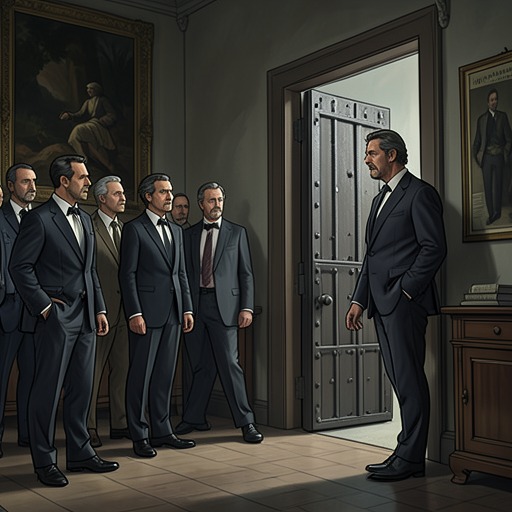
Jana Nambodri
Serious MenJana Nambodri, the Institute’s convivial Deputy Director and a radio astronomer, is both Arvind Acharya’s oldest friend and his most persistent institutional opponent. Nambodri wants the Giant Ear to search for extraterrestrial intelligence; Acharya refuses to permit it. Their conflict becomes a contest over what counts as science and who gets to decide what the Institute may pursue, while their history gives the contest the painful intimacy of a friendship repeatedly forced into opposition.
Identity and Scientific Commitment
Nambodri enters as a cheerful presence at the Institute’s door, holding it open and greeting the room. His silver hair, described as a wave, distracts Ayyan Mani; his corduroy trousers are a recurring personal eccentricity. The warmth of his manner does not make him politically passive. He is at the center of the dispute over the Giant Ear, and his central aim is specific: to use the radio telescope array to search the skies for signals from extraterrestrial intelligence.
He argues for the search on grounds of possibility and the pursuit of knowledge, not merely institutional advantage. When Acharya dismisses the project as nonsense and says the Institute is not interested in money, Nambodri points out that universities have offered attractive usage fees. The exchange exposes the conflict’s practical dimension—how a major research instrument will be used—but neither man reduces his position to funding. Acharya claims the authority of “real science” for his preferred research; Nambodri insists that even a small mathematical possibility can justify searching for truth. For him, hope is part of scientific inquiry rather than evidence of its corruption.
Friendship Turned into Rivalry
Nambodri’s opposition is sharpened by his knowledge of Acharya’s past. He remembers the friend he knew in Princeton as a lanky, mischievous young man, far removed from the formidable Director who now antagonizes colleagues in the name of conviction. Their long familiarity makes Nambodri’s challenge more than a dispute between administrators: he sees a changed person where Acharya sees an opponent who must be removed. Even as he plots how to find political ground on which Acharya is less powerful, Nambodri’s recollection conveys bewilderment at the distance between their earlier hopes and their present conflict.
He first presses the case through ordinary institutional argument. He reminds Acharya that a SETI conference is taking place in Paraguay, to which Professor Jal has been invited, and raises the international interest in the Giant Ear. Acharya answers with ridicule and refuses to authorize the work. Nambodri persists, arguing that radio astronomers around the world want access and that members of their own Institute are unhappy with the ban. Acharya counters that the search imagines aliens too much like human beings and mistakes human loneliness for science. Nambodri’s defense is less a claim that extraterrestrial life must resemble humanity than a claim that uncertainty does not disqualify a search: an unlikely possibility may still warrant investigation.
The dispute becomes openly political when Nambodri raises it before the Institute’s scientists. After discussion of other matters, he deliberately brings the Giant Ear question back to Acharya, beginning with a wavering voice that grows more assured. He says that the Balloon Mission is not the Institute’s only important work and places the radio astronomers’ discontent on the table. In doing so, he makes a private disagreement into a collective complaint: Acharya has repeatedly refused access to the Giant Ear and publicly declared SETI not to be science, while Nambodri says colleagues regard that stance as autocratic and unfair. His intervention risks a direct confrontation, but it also gives dissent a public form.
Strategy, Defeat, and Return
Nambodri’s challenge is not only a matter of principle. After Acharya’s opponents leave a tense meeting, Nambodri asks whether Acharya has been calling powerful figures, including the Prime Minister or the President, and declares that he wants Acharya out. Acharya, in turn, demands to know what Nambodri wants. Nambodri answers simply that he wants to search for extraterrestrial intelligence. The exchange brings their conflict to its starkest form: one man’s stated scientific objective is also the cause around which he has assembled an institutional challenge to the other’s authority.
That challenge fails as a mutiny to establish SETI as an autonomous department. In its aftermath Nambodri is described as subdued and humiliated by Acharya’s decision to pardon him. His defeat does not erase his purpose, but it changes his position: he has tried to wrest authority from Acharya and lost, leaving him to return to the dispute under the shadow of that failure. The humiliation matters because the rivalry is personal as well as procedural. These are not distant factions; they are old friends whose conflict has become a test of power inside an institution they helped shape.
Nambodri later finds another route to influence during the internal proceedings against Acharya. The trial lasts only a day. After Oparna Goshmaulik departs, Balloon Mission postdoctoral students appear nervous and do not pursue the sampler case. The inquiry instead hears complaints from thirteen scientists who say Acharya mentally tortured them. The narrative identifies this change of focus as Nambodri’s masterstroke. Although the evidence against Acharya is thin and the sampler allegations do not carry the case forward, Nambodri understands that the complaints of colleagues can inflict institutional damage when Acharya is vulnerable. His strategy turns the accumulated resentment of the Institute into a force that the earlier direct challenge could not command.
Acting Director and the Friendship That Remains
At the announcement of the inquiry’s findings, Bhaskar Basu tells reporters that Acharya confessed to ordering Oparna to falsify research intended to support a claim of life at forty-one kilometres above Earth. Basu also cites misuse of Institute funds and Acharya’s treatment of colleagues, announces his suspension, and names Nambodri acting Director. The elevation fulfills the political reversal implicit in their conflict, but it is presented amid the Institute’s disgrace, not as a simple victory. Nambodri takes the large black chair and makes a joke denying the Big Bang; those present laugh. The scene gives him the outward ease of a new incumbent while connecting his first moment in the chair to the very scientific controversy that divided him from Acharya.
The relationship does not settle into uncomplicated triumph. When scientists later gather to acknowledge Acharya as a discoverer, Nambodri arrives and tells his friend that something in him dies when a friend does well; they embrace. The gesture preserves both sides of their history. Nambodri has opposed Acharya, helped bring about his suspension, and gained the acting directorship, yet he can still share in the recognition Acharya receives. Their embrace does not undo the conflict; it shows that professional defeat and personal attachment coexist.
Later, when the Institute’s astronomers question Ayyan Mani about the alleged theft of the Joint Entrance Test, Nambodri asks how Ayyan managed it. His questions come after Professor Jal angrily interrupts Ayyan’s evasive answers, and Nambodri’s position is now that of the authority conducting the inquiry rather than the insurgent challenging Acharya. Ayyan denies knowing what Nambodri means. The scene extends Nambodri’s role in the Institute’s power structure beyond the SETI dispute: he is present when the institution turns its attention toward Ayyan and his son, Aditya Mani.
Narrative Role and Significance
Nambodri gives the Institute’s SETI controversy a human and political center. He articulates a scientific case for pursuing a possibility even when certainty is unavailable, while Acharya draws a boundary around what he considers legitimate science. Their arguments are also arguments over access, authority, and whose dissatisfaction counts. Nambodri’s career traces the consequences: persuasion becomes public dissent, dissent becomes a failed power challenge, and institutional maneuvering later helps make him acting Director.
Yet the novel resists reducing him to either a principled scientist or an opportunist. His belief in searching for extraterrestrial intelligence remains plain, as do his use of collective grievances and his advantage from Acharya’s downfall. The old friend who once hoped alongside Acharya becomes his rival and successor, but the embrace after Acharya’s discovery keeps their bond visible inside that reversal. Nambodri’s significance lies in that unresolved combination: the search for truth, the struggle to define science, and the ordinary hunger for power all occupy the same Institute—and the same friendship.